
By BongNewsLive | August 6, 2025
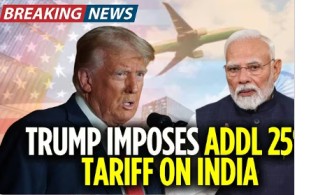
In a bold and controversial move, former U.S. President Donald Trump has declared a 25% additional tariff on Indian imports to the United States, set to take effect 21 days from now. This announcement, delivered during a high-energy campaign rally in Michigan, has triggered a wave of concern across global markets and sparked renewed debates on U.S.-India trade dynamics.
This is not merely a policy decision — it’s a geopolitical signal. As Trump eyes another presidential run in 2028, this tariff announcement seems carefully timed to appeal to his core base of American manufacturers and economic nationalists. But the ripple effects go far beyond U.S. borders.
What Exactly Did Trump Announce?
Donald Trump stated that all goods imported from India would face an additional 25% tariff, applicable from the end of August 2025. While the full list of affected products has not yet been released by the United States Trade Representative (USTR), insiders suggest that pharmaceuticals, textiles, software services, electronics, and automotive components are expected to be impacted.
“We’re done letting other nations take advantage of our economy. India’s time of getting easy access to American markets is over,” Trump told a cheering crowd.
His remarks were met with enthusiastic applause from supporters but drew strong criticism from trade analysts and economists who warn of wider economic consequences.
🇺🇸 Why Target India?
India has been a growing trade partner of the United States, with bilateral trade reaching over $190 billion in 2024. Yet, Trump’s decision appears driven by several long-standing issues:
1. Persistent Trade Deficit
The U.S. consistently runs a trade deficit with India — meaning it imports more than it exports. Trump has frequently pointed to this as evidence of “unfair” trade.
2. Barriers to U.S. Companies
U.S.-based corporations often complain of complex Indian regulations, particularly in retail, e-commerce, and agriculture. Restrictions on foreign direct investment and local data storage laws have frustrated companies like Amazon and Walmart.
3. Old Tariff Tensions
This isn’t the first time tensions have risen. In 2019, India retaliated with its own tariffs after Trump ended the Generalized System of Preferences (GSP) — a program that previously allowed Indian goods into the U.S. duty-free. Trump’s latest move appears to reopen those wounds.
What Does This Mean for India?
The impact on India could be significant — both economically and politically.
Economic Impacts:
- Export Slowdown: Sectors like textiles, IT services, and generic drugs heavily rely on U.S. buyers. These sectors may see reduced orders or contract renegotiations.
- Rupee Volatility: Currency fluctuations are likely, as India adjusts to lower trade inflow and potential investor uncertainty.
- SME Struggles: Many small and medium exporters who ship goods to the U.S. could face severe losses unless they pivot quickly.
Political Response:
India’s Ministry of External Affairs issued a cautious response, stating:
“We are reviewing the announcement carefully and will respond in accordance with our national interest and international trade norms.”
Behind the scenes, however, India is reportedly preparing a formal protest at the World Trade Organization (WTO) and may consider reciprocal duties on select American imports such as almonds, apples, and motorcycles.
What Happens to U.S. Consumers?
American consumers and businesses could also feel the pinch. India supplies a wide range of affordable goods to the U.S., from prescription drugs and software solutions to cotton garments and spices.
Likely outcomes:
- Price Hikes: Consumers may see a rise in prices of everyday items like over-the-counter medications, herbal supplements, and clothing.
- Business Disruption: U.S.-based companies that rely on Indian tech talent and outsourcing may face cost increases or service delays.
- Healthcare Impact: Indian generics help maintain low costs in American healthcare. This move could result in increased expenses for both insurers and patients.
Global Reactions: A Mixed Bag
Other world powers are watching the situation closely. Several European trade experts warned that this unilateral move could destabilize global trade routes, especially at a time when supply chains are already under stress due to climate challenges, geopolitical tensions, and post-pandemic adjustments.
EU Trade Commission:
“We encourage restraint and constructive dialogue between partners, rather than aggressive tariff escalations.”
Interestingly, China has not commented officially, though analysts suggest that Beijing might benefit in the short term by positioning itself as a more stable trade partner for India or the U.S.
Will This Help Trump Politically?
Trump has long positioned himself as a defender of American industry. His base, particularly in manufacturing-heavy states like Ohio, Pennsylvania, and Michigan, may view this move as a positive sign of renewed economic nationalism.
However, critics argue that the short-term optics may come at the cost of long-term global partnerships. As the U.S. navigates a competitive global market, alienating rising economies like India may hurt more than it helps.
Expert Opinions: Divide Down the Middle
Here’s what industry experts and economists are saying:
- Dr. Ramesh Chadha, Trade Economist (New Delhi):
“This will disrupt hundreds of small exporters who depend on consistent U.S. demand. India must diversify quickly.” - Michael Brunner, U.S. Chamber of Commerce:
“While we understand the need to protect local industries, blanket tariffs may cause more harm than good.” - Nandita Raje, Policy Analyst:
“It’s a strategic gamble — one that could work politically for Trump but may damage long-term relations with a key democratic ally.”
What Should Indian Exporters Do Now?
With only three weeks’ notice, businesses must act fast. Here are some expert recommendations:
- Revisit Pricing and Contract Terms: Factor in the new duty when negotiating with U.S. buyers.
- Explore Alternate Markets: EU, ASEAN, and Middle Eastern countries offer growing demand for Indian products.
- Enhance Local U.S. Presence: Partnering with or investing in U.S.-based facilities could reduce tariff exposure.
- Stay Informed: Monitor updates from India’s Ministry of Commerce and USTR for final product lists and exemptions.
Turning Point or Temporary Setback?
Trump’s 25% tariff on Indian imports is more than just an economic decision — it’s a geopolitical signal, a campaign strategy, and a trade gamble all rolled into one.
For India, it’s a wake-up call to reduce dependency on single-market exports and build stronger, diversified trade partnerships. For the U.S., it’s a high-stakes bet to boost local manufacturing at the potential cost of rising prices and diplomatic backlash.
What remains to be seen is how this plays out — whether as a temporary flashpoint, a permanent policy shift, or a strategic misstep in a world already walking a tightrope of trade and diplomacy.
Sources:
- USTR Official Portal: https://ustr.gov
- Press Information Bureau, India: https://pib.gov.in
- Economic Times India, August 6, 2025
- Live Telecast of Trump Rally, Michigan, August 5, 2025
- Interviews from CNBC-TV18 & NDTV Trade Analysts